

From Coverage to Congestion: How Geo-Located Analytics Prioritize What Matters Most

In the world of mobile networks, delivering coverage is no longer the only benchmark for quality. Today, congestion, interference, and localized service degradation often define the true subscriber experience—especially in dense, multi-technology environments.
But how do operators decide where to act first?
With thousands of cells and millions of KPIs generated daily, identifying and addressing the most pressing issues can feel like chasing shadows. That’s where geo-located analytics—like those enabled by Aircom’s Mentor platform—make the difference.
The Problem with Traditional Monitoring
Most network monitoring systems are still cell-centric, showing alarms or KPIs per site or sector. But these systems often miss spatial correlations—for example:
- A coverage hole affecting multiple cells in an urban junction
- A capacity hotspot near a stadium or transit hub
- A consistent drop zone along a specific road corridor
These aren’t isolated incidents. They’re location-driven patterns that require a different lens.
How Mentor Adds Spatial Intelligence
Aircom’s Mentor suite brings geo-location to the heart of RAN troubleshooting and optimization.
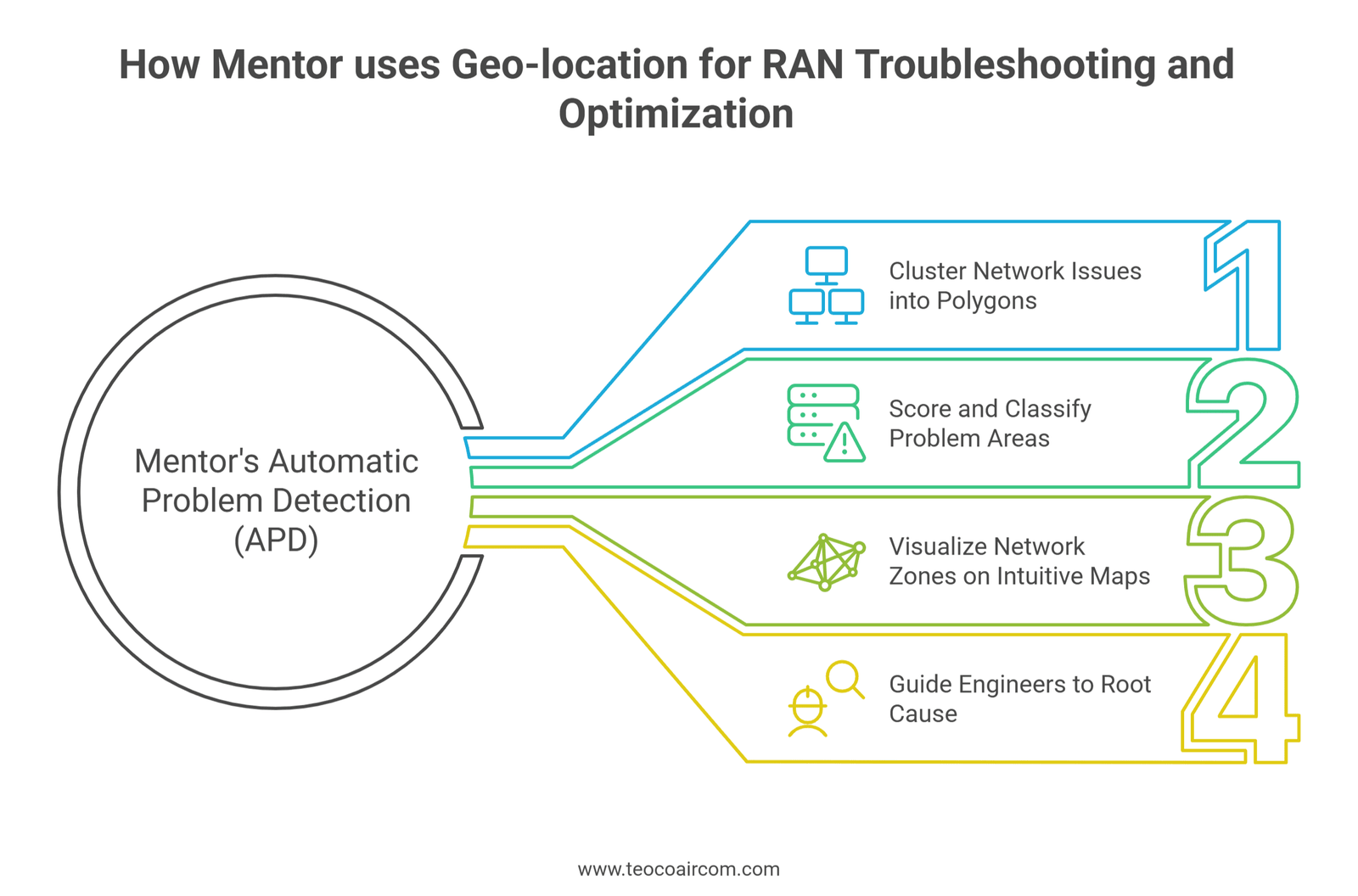
Through its Automatic Problem Detection (APD) capability, Mentor analyzes call traces and performance counters to:
- Cluster network issues into polygons, based on traffic density or events
- Score and classify each problem area (such as drops, congestion, interference)
- Visualize these zones on intuitive maps, with severity indicators and drill-down access
- Guide engineers to the root cause, whether it’s a single cell or a systemic pattern across multiple technologies
By surfacing problems in context, Mentor helps prioritize not just what’s broken—but what matters most.
From Noise to Actionable Insight
Instead of reacting to complaints or generic threshold breaches, operators using Mentor can:
- Focus on high-impact zones (such as VIP areas, enterprise sites, transport corridors)
- Compare current vs. historical problem patterns to track improvement or degradation
- Correlate problem areas with cell, sector, and configuration data to accelerate resolution
- Feed location-based insights into planning, optimization, and customer care workflows
This leads to a more proactive, experience-focused approach to network health—shifting the narrative from coverage to service consistency.
Why It Matters
When engineers know where issues affect users the most, they can fix the right problems faster. And when CXOs have visibility into spatial service quality, they can make smarter decisions about investment, partnerships, and SLAs.
In a world of high expectations, rising traffic, and scarce RF resources, geo-located analytics aren’t just a nice-to-have—they’re operationally essential.
Final Thought
Mentor doesn’t just show you what’s happening—it shows you where it matters.
By bringing location intelligence to network optimization, Aircom enables operators to move from scattered KPIs to targeted, data-driven performance improvement—boosting customer satisfaction, reducing churn, and maximizing engineering impact.
How can we help?
For over 30 years, Aircom has helped network operators run state-of-the-art mobile networks and profitable businesses. Learn how we can help you in the areas critical to the success of modern CSPs.