

Orchestrating Change In A Multi-Vendor RAN Environment

Most automation challenges in multi-vendor networks don’t come from bad logic; they come from mapping the automation logic on the parameters and capabilities of each vendor.
This is exactly the problem Aircom’s SmartCM Orchestrator is built to solve.
In multi-vendor RAN environments, defining a change is rarely the issue. Executing it consistently and accurately across the vendors is. The intended action has to be mapped through different data models, protocols, and activation mechanisms—and that’s where automation fragments and execution becomes complicated and potentially costly.
At scale, this is not a speed problem. It is a consistency problem—with direct financial impact.
The Cost of Inconsistent Execution
As automation and AI increase the rate of change across networks, the complexity of managing the configuration actors increases exponentially. When multi-vendor network are present, they compound the problem.
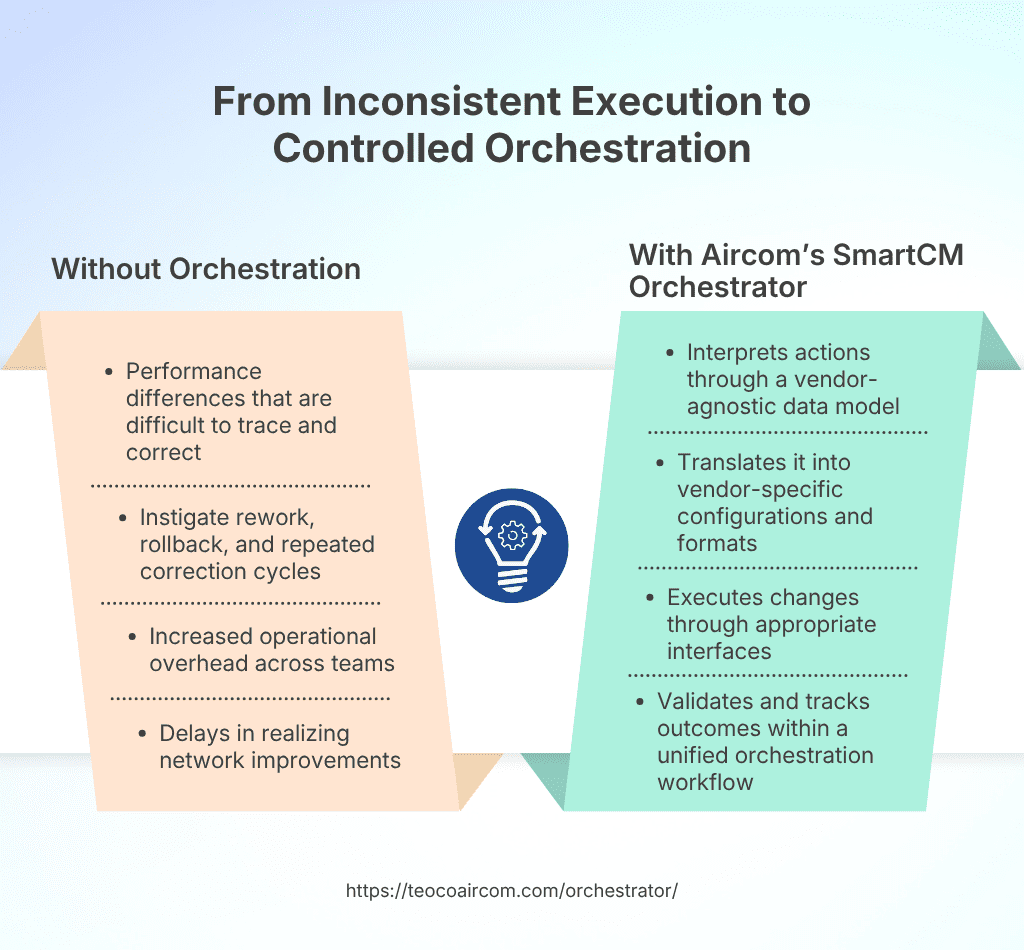
When the same change is executed differently across vendors, it leads to:
- Performance differences that are difficult to trace and correct
- Instigate rework, rollback, and repeated correction cycles
- Increased operational overhead across teams
- Delays in realizing network improvements
Over time, this translates into higher OPEX, slower time-to-impact for optimization initiatives, and inefficient use of engineering resources.
At scale, the cost is not just technical inefficiency—it is financial leakage driven by inconsistent execution.
Business Rules: The Missing Layer
Scaling automation across multi-vendor environments requires an even clearer understanding of what is possible for each vendor. And consistency in performance across the whole network is dependent on mapping intent reliably across all vendors.
Without this layer, vendor-specific logic gets embedded into every workflow, forcing operators to manage parallel processes across domains. This makes automation harder to scale and maintain—especially as AI-driven use cases increase.
A concise library of business rules enables operators to:
- Define changes once at a logical level leveraging the corresponding rules
- Decouple operational intent from vendor-specific implementation
- Avoid duplicating workflows across vendors and domains
This is what allows automation to move from fragmented execution to controlled, scalable and cost efficient operations.
How SmartCM Orchestrator Solves This
SmartCM introduces a structured rules-based layer to map intent and execution.
Operators define rules across the framework once, and these prevail across all activities across the whole network. SmartCM then:
- Interprets actions through a vendor-agnostic data model
- Translates it into vendor-specific configurations and formats
- Executes changes through the appropriate interfaces
- Validates and tracks outcomes within a unified orchestration workflow
This ensures that a single logical action results in consistent execution across Ericsson, Huawei, ZTE, and other vendor environments.
The complexity is not removed.
It is orchestrated systematically—within a single controlled framework.
Without orchestration, execution becomes fragmented and risk accumulates across systems. With orchestration, every action—human, automated, or AI-driven—follows the same policy-driven path.
AI at the Heart of Orchestration
Embedding AI in the orchestration process supports users in defining and managing the rules layers. This is critical to govern all actors consistently and transparently. AI assistants in SmartCM enable users to validate, create and augment rules easily with 100 percent efficacy . This is what allows automation to scale without amplifying inconsistency.
From Intent to Execution: A Practical View
Consider a network-wide parameter update across a multi-vendor RAN.
With SmartCM, the operator defines the change once at a logical level. The platform then:
– Translates the change into vendor-specific formats
– Executes each action through the correct interface
– Validates the implementation against predefined rules
– Tracks the outcome within a unified orchestration workflow
The result is a consistent, controlled, and fully traceable execution process—regardless of vendor diversity.
The Bottom Line
Automation does not fail because networks are complex.
It fails when that complexity of the intended action is not managed during execution.
In multi-vendor environments, consistency is not automatic.
It has to be abstracted, controlled, and orchestrated.
Aircom’s SmartCM Orchestrator ensures that every change—no matter how simple at a logical level—is executed consistently across the network, enabling automation and AI to deliver measurable outcomes at scale.
How can we help?
For over 30 years, Aircom has helped network operators run state-of-the-art mobile networks and profitable businesses. Learn how we can help you in the areas critical to the success of modern CSPs.