

From Configuration Management to Intelligent Orchestration

For years, operators have invested heavily in visibility—knowing exactly how their networks are configured and where they deviate from plan. But as networks scale and operations accelerate, a new challenge has emerged:
Visibility is no longer the challenge but execution is.
Today’s RAN environments are defined by continuous change. More and more automation is added to increase operational speed, and even AI is beginning to influence decision-making. Planning tools, optimization systems, and multiple engineering teams are all contributing inputs. The result is not just complexity—but a growing gap between knowing what needs to change and ensuring it happens correctly accommodating the urgency and importance of each action .
This is where the shift to intelligent orchestration begins.
The Limits of Static Configuration Management
Configuration management answers a fundamental question: Is the network configured as intended?
By comparing live and planned states either manually or automatically, engineers can identify discrepancies and provide clarity. But it often stops short of execution.
In many cases once an issue is identified, responsibility shifts outward—often to engineers, scripts, or fragmented automation processes to complete the task. Even where automation exists, it typically operates in isolated steps rather than as a unified system. At scale, this creates a structural gap: intended actions are clear but execution remains opaque, often inconsistent, and not continuously aligned or assured.
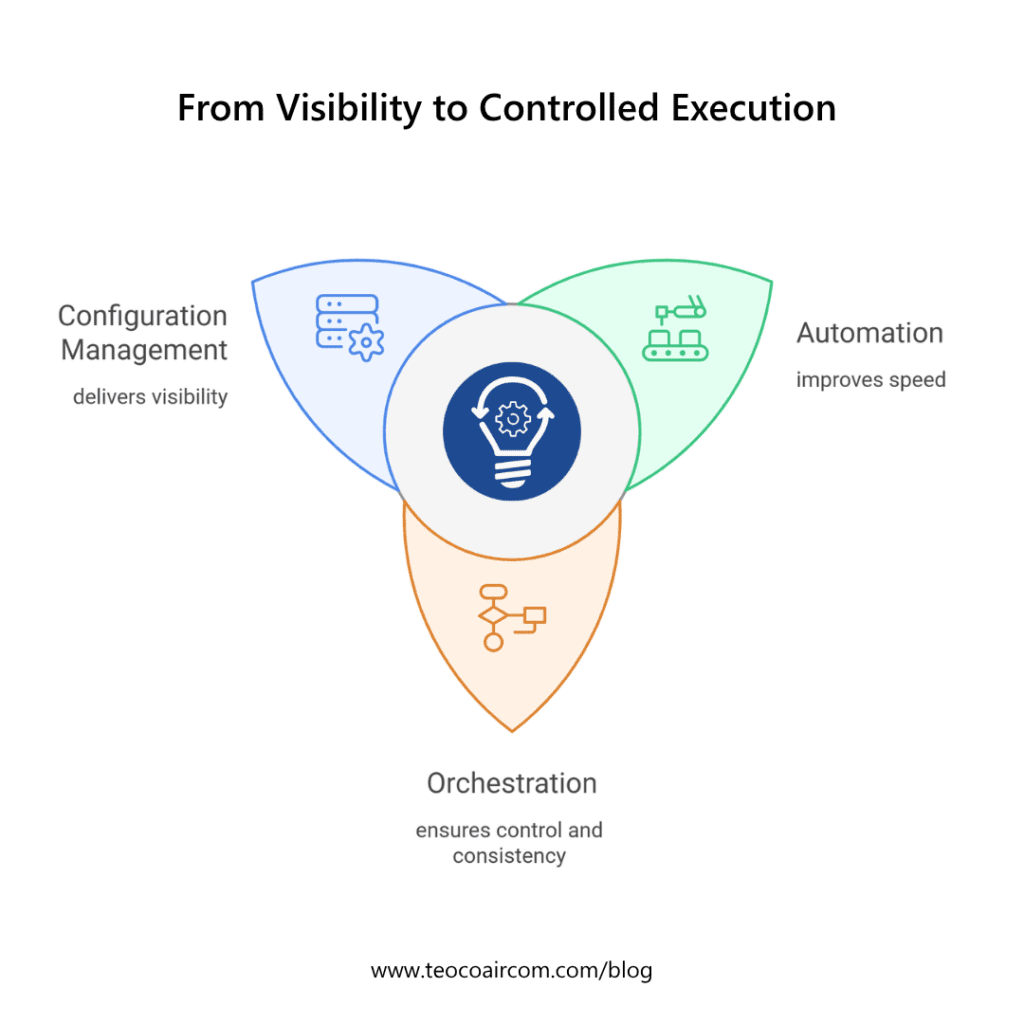
From Visibility to Controlled Execution
Modern networks require more than awareness—they require reliable execution of change.
Orchestration connects detection, decision, and execution into a single, governed process.
- Configuration management delivers visibility
- Automation improves speed
- Orchestration ensures control and consistency
This is what allows operators to manage the increase in complexity without introducing instability.
What Changes with Orchestration
In an orchestrated environment, network state becomes an input for action or actions, and not just reporting.
When a discrepancy or a fault is detected, or an intervention is required, it is interpreted, evaluated against policies, and translated into a validated change. That change is then executed in a controlled way across systems and vendors. And the operator remains in control irrespective of the number of actors in the system
Increasingly, this is supported by closed-loop workflows—where issues are detected, corrected, and verified continuously.
Every action follows a consistent path:
- Derived from network state
- Validated against rules and policies
- Executed with control and traceability
The result is not just faster operations—but accurate and predictable outcomes.
A Practical Example
Consider a mismatch between planned and live configuration.
Traditionally, this would trigger manual investigation, correction, validation, and execution. Even with automation, these steps are often loosely connected.
With orchestration, the process is unified.
The system identifies the issue, determines the correction, critically validates it against policies, and executes it across vendor and technology systems as required. Failures are handled automatically, and outcomes are verified.
What was fragmented becomes a closed, controlled workflow—from detection to execution.
Why This Shift Matters
As networks evolve, the volume and frequency of change continue to grow.
Automation improves efficiency, and AI enhances decision-making—but both also increase activity. Without structured execution and policy control, this leads to inconsistency, risk, and growing reliance on manual intervention.
Orchestration ensures that every action—whether human, automated, or AI-driven—follows a consistent, policy-driven path.
It brings discipline to execution at the same scale that automation brings speed.
Where SmartCM Fits In
SmartCM operates across this lifecycle.
It establishes a rules based framework that evaluates network state, detects discrepancies and faults , generates corrective actions, and manages execution through controlled interaction with OSS systems—ensuring validation, governance, and traceability.
By combining configuration management, automation, and orchestration into a unified framework, SmartCM Orchestrator enables policy-driven, closed-loop network operations at scale.
The Bigger Shift
The move from configuration management to orchestration reflects a deeper change in network operations.
As networks become more dynamic and increasingly shaped by automation and AI, control over execution becomes just as critical as visibility.
Configuration management is no longer just about accuracy.
It is becoming the control layer for modern network operations.
And as the industry moves toward autonomous networks, orchestration will ensure that automation delivers not just speed—but consistent, reliable outcomes at scale.
How can we help?
For over 30 years, Aircom has helped network operators run state-of-the-art mobile networks and profitable businesses. Learn how we can help you in the areas critical to the success of modern CSPs.