

Beyond Heatmaps: Monitoring VIP Experience with Geo-Located Call Traces

In modern mobile networks, subscriber satisfaction is no longer just a function of broad coverage or fast theoretical speeds. It is about consistency, reliability, and how the network performs for the services—and people—that matter most. Whether it’s a financial executive relying on uninterrupted video calls, an enterprise customer demanding SLA adherence, or a high-ARPU VIP subscriber using a 5G device in a dense urban environment, mobile operators need insights that go beyond network-wide averages.
To deliver differentiated and dependable service to these high-value users, operators must shift their focus from traditional network-centric KPIs to geo-located call trace analytics—a capability that allows them to monitor, troubleshoot, and optimize subscriber experience with far more context and precision.
Aircom’s Mentor platform brings this capability to life—bridging the gap between passive performance monitoring and subscriber-centric decision-making.
Why Cell-Level PM KPIs Alone Are Not Enough
Performance Management (PM) KPIs aggregated at the cell level are foundational for monitoring network health. However, they often miss localized degradation or fail to highlight how issues affect specific subscribers or services.
For example:
- A sector may show acceptable average throughput, while a VIP subscriber frequently experiences buffering at the cell edge.
- Handover success rates might appear healthy overall, yet a group of enterprise users may face repeat drops in a single location.
To uncover these blind spots, operators need geo-located analytics derived from call traces. These not only expose where the network is underperforming, but also link issues directly to the affected subscribers or service types.
What Are Geo-Located Call Traces?
Geo-located call traces combine signaling and user session data with spatial coordinates. Whether visualized as heatmaps or filtered to highlight specific subscriber events, these insights help engineers understand the network’s behavior from the user’s point of view.
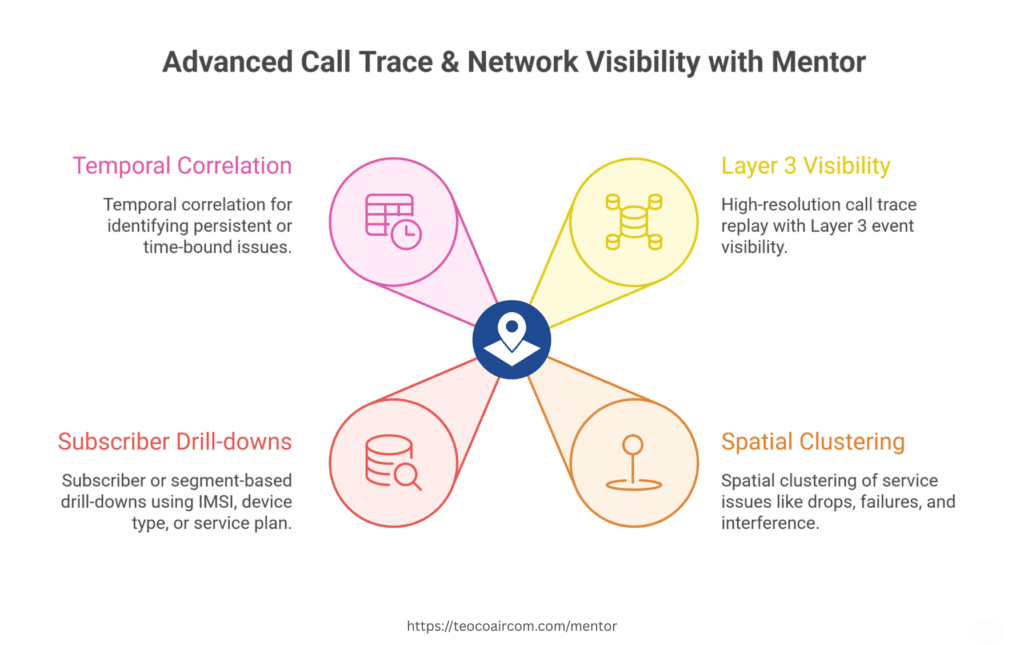
Mentor, Aircom’s advanced analytics and optimization platform, supports:
- High-resolution call trace replay with Layer 3 event visibility
- Spatial clustering of service issues (e.g., drops, failures, interference)
- Subscriber or segment-based drill-downs (e.g., IMSI, device type, service plan)
- Temporal correlation for identifying persistent or time-bound issues
Geo-located data can be visualized through heatmaps for broader insights or tied to specific subscribers—such as VIPs—when precision is required.
Monitoring VIP Experience: A Practical Use Case
Consider a tier-1 operator managing VIP subscribers across a commercial business district. These users expect high QoS, but internal support tickets have begun surfacing with complaints of poor call quality and session drops.
While cell-level PM KPIs showed no obvious issues, geo-located call trace maps—generated in Mentor—revealed:
- Congestion in a small area impacting multiple calls tied to VIP IMSIs
- Repeat handover failures between co-located cells in a high-rise environment
- Uplink quality degradation correlated to specific time intervals and indoor mobility
Armed with this spatial intelligence, engineers were able to:
- Tune neighbor list parameters and balance loads across overlapping sectors
- Resolve interference caused by an underperforming indoor DAS
- Validate improvements by tracking the specific VIP users in subsequent trace data
This level of insight was only possible by bridging call trace data with location, not by relying on PM KPI dashboards alone.
Strategic Implications for the Business
For decision-makers, the impact is clear:
SLA Assurance
Geo-located traces provide defensible proof for SLA reporting and resolution timelines.
Targeted Investment
Resources can be allocated precisely where premium users are affected.
Retention Strategy
High-ARPU and enterprise subscribers are more likely to churn when their issues go unresolved or undetected.
In an era of private networks, network slicing, and tailored services, being able to see and act on subscriber-level experience is mission-critical.
From Network-Centric to Experience-Centric
Mobile networks have evolved. So must the tools used to manage them.
While PM-based KPIs provide broad, infrastructure-level awareness, it’s the geo-located call trace data that empowers operators to connect the dots between network behavior and subscriber outcomes.
Whether visualized as heatmaps for a region or isolated events for VIPs, this analytics layer helps engineering and commercial teams align on what matters: delivering measurable improvements to subscriber experience.
With Aircom’s Mentor, operators can finally move beyond averages—and into location-aware, experience-driven RAN optimization.
How can we help?
For over 30 years, Aircom has helped network operators run state-of-the-art mobile networks and profitable businesses. Learn how we can help you in the areas critical to the success of modern CSPs.