

Designing with Data: Closing the Loop Between Network Experience and RAN Planning

Modern mobile networks can no longer afford to operate in silos. With rising complexity in user behavior, spectrum usage, and radio environments, it is no longer sufficient to plan once and optimize later. Effective RAN expansion today depends on tightly coupled feedback loops—where real-world network experience directly informs future RAN planning decisions.
At the heart of this closed-loop model lies the interplay between Aircom’s Mentor and ASSET platforms. While ASSET remains the industry benchmark for radio network design and capacity planning, it is Mentor that continuously feeds back intelligence from the field—providing geo-located insights based on actual user sessions. Together, they form a powerful foundation for experience-driven RAN lifecycle management.
Why Static Planning Falls Short in Evolving Networks
RAN planners traditionally rely on predicted traffic models, demographic forecasts, and RF simulation to drive rollout decisions. But even the best-designed plans lose accuracy once real-world variables kick in, such as:
- Building interference not captured in simulation
- Offloading behavior between layers and RATs
- Device usage patterns shifting between indoor and outdoor zones
- Temporal peaks misaligned with assumed busy hours
These factors create a performance gap between what the network was designed to do and what it’s actually delivering. Without a reliable mechanism to detect and correct this drift, operators risk investing in sites that underperform—or worse, miss high-demand areas entirely.
Mentor’s Role: Grounding Planning in Reality
Aircom’s Mentor platform captures geo-located traces from subscriber call sessions across technologies, transforming performance data into location-aware insights. Unlike cell-level PM KPIs, which offer averages and trends, Mentor provides:
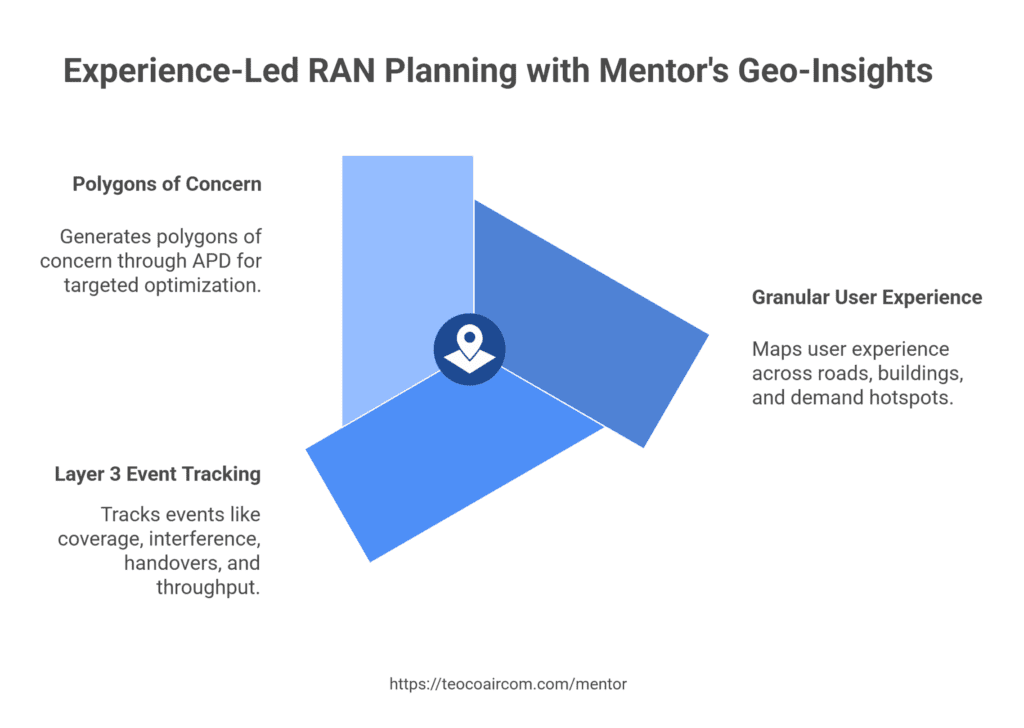
- Granular user experience mapping across specific roads, buildings, and demand hotspots
- Layer 3 event tracking tied to coverage, interference, handovers, and throughput
- Polygons of concern generated through APD (Automatic Problem Detection) for targeted optimization
This real-world intelligence enables planners and optimization teams to answer key questions:
- Are newly deployed sites serving the intended traffic zones?
- Where are users experiencing drops or low quality despite acceptable coverage predictions?
- Which clusters show unplanned indoor or vertical traffic demand?
Mentor doesn’t just identify where the network is underperforming—it reveals why and where to act next.
ASSET + Mentor: The Feedback Loop in Action
Where Mentor ends, ASSET begins. Using feedback from Mentor’s analytics, engineers can revisit their planning assumptions in ASSET and:
- Correct site azimuth and tilt plans
- Model actual subscriber distributions in dense urban grids
- Update candidate lists or suggest small cell placements based on real traffic hotspots
- Simulate alternate designs using demand-weighted maps from actual user data
Through direct integration or data exchange between the platforms, Aircom enables a feedback-informed planning cycle that continuously improves precision and ROI.
Use Case: Post-Launch Validation to Expansion
Consider a nationwide 5G rollout where clusters are being activated sequentially. Upon activation:
- Mentor validates new site performance via call trace analysis, detecting underutilized sectors and early traffic shifts.
- Problem polygons or capacity zones are reviewed to validate planned coverage vs. actual coverage by optimization teams.
- The ASSET planning team pulls this geo-intelligence back into the model to determine if more small cells are needed—or if tilt/power adjustments can address emerging gaps.
This tight loop enables not just post-launch assurance, but informed expansion planning rooted in evidence, not assumption.
From Predictive to Adaptive Networks
Networks that learn from themselves can plan smarter. By bringing Mentor’s subscriber-level geolocation intelligence into the ASSET design process, operators gain a powerful edge:
- More accurate ROI modeling for future builds
- Efficient spectrum reuse through demand-weighted expansion
- Higher QoS and reduced churn by targeting true pain points
- Reduced OPEX through fewer unnecessary field visits and redesigns
This is not theory—it’s adaptive RAN engineering in practice.
In a 5G world defined by complexity, scale, and constant change, Aircom’s Mentor + ASSET synergy equips operators to design networks not just for coverage—but for relevance, responsiveness, and resilience.
How can we help?
For over 30 years, Aircom has helped network operators run state-of-the-art mobile networks and profitable businesses. Learn how we can help you in the areas critical to the success of modern CSPs.