
From Detection to Verified Outcomes: Closed-Loop RAN Automation

Most network automation doesn’t fail because actions aren’t executed. It fails because those actions aren’t controlled from intent to outcome.
That’s the gap Aircom’s SmartCM is designed to close.
You detect an issue.
An alarm is raised.
A script runs.
A change is pushed.
On paper, that’s automation.
In reality, control is still missing.
Because the system hasn’t answered the only question that matters: Did the network actually achieve the intended state?
Why Execution Alone Isn’t Automation
In large-scale RAN environments, execution is only one step in a much larger process.
Without an end to end control of the closed loop:
- Actions are triggered, but outcomes are not confirmed
- Temporary conditions lead to unnecessary changes
- Failed executions go unnoticed or are retried blindly
- The network drifts away from intended configuration over time
What appears as automation becomes a sequence of uncoordinated actions.
At scale, this creates inefficiency, instability, and hidden operational cost.
Closing the Loop
True automation is not about triggering actions. It is about controlling outcomes to achieve intent.
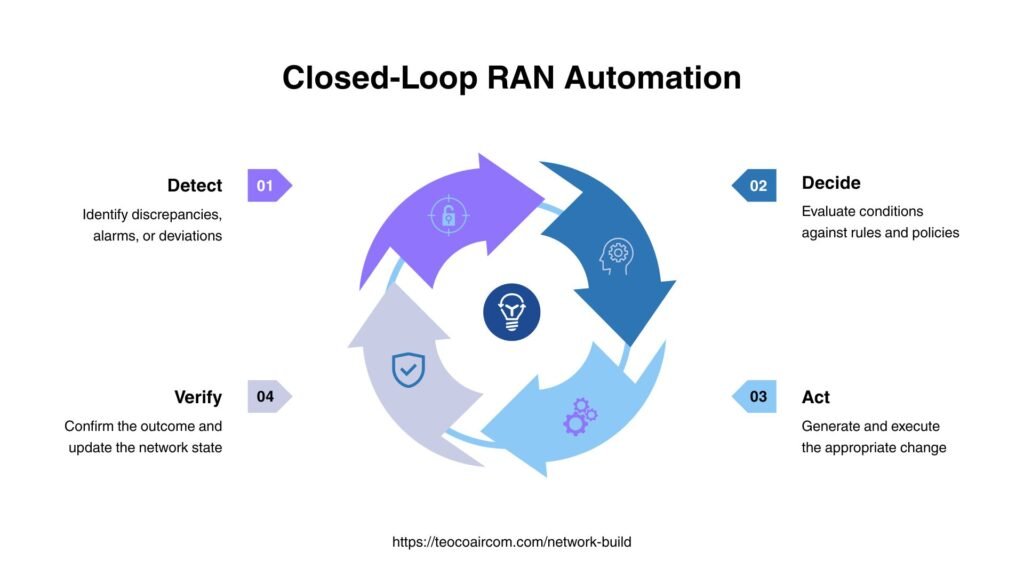
This requires a continuous cycle:
- Detect — identify discrepancies, alarms, or deviations
- Decide — evaluate conditions against rules and policies
- Act — generate and execute the appropriate change
- Verify — confirm the outcome and update the network state
The loop only closes when the outcome is validated—not when the action is executed.
Where SmartCM Changes the Model
SmartCM brings the closed loop into a governed orchestration framework. RAN Intelligence helps define and trigger automation workflows using inputs such as configuration, fault, performance, planning, inventory, and external data. SmartCM Orchestrator then controls how those actions are executed through verification, validation, scheduling, transcript generation, OSS gateway interaction, and API integration.
This means every action is not only triggered by network conditions but crucially, it is checked against operator rules, approved or prioritized where needed, executed through the right interface, and tracked through to outcome.
That makes the loop operational, not theoretical.
From Reaction to Controlled Response
Consider a common scenario: a cell outage alarm.
In a typical setup, this triggers immediate action. But not every alarm requires intervention—and not every action leads to resolution.
With SmartCM:
- The condition is first evaluated (e.g., duration, severity, context)
- Policies determine whether action is required
- The system executes the appropriate response
- If execution fails, retries are managed intelligently and transparently
- If the condition clears, rollback or no-action logic applies
- The outcome is verified before the process is closed
And the operator is in full control of these processes.
What changes is not just the action—but the discipline of execution.
Automation in an AI-Driven Network
As AI-driven decision-making increases, so does the volume of actions.
Without closed-loop control:
- AI can trigger actions faster than they can be validated
- Conflicts and inconsistencies increase
- Trust in automation declines
Closing the loop ensures that every action—human, automated, or AI-driven—follows the same controlled path.
This is what allows automation to scale without amplifying risk.
The Bottom Line
Automation does not deliver value because actions are executed.
It delivers value when intended outcomes are achieved—and verified.
In modern networks, that requires more than speed.
It requires closed-loop control.
SmartCM ensures that every action is part of a continuous, governed loop—from detection to verified outcome—turning automation into something far more reliable:
A system that doesn’t just act, but knows when it intends to do.
How can we help?
For over 30 years, Aircom has helped network operators run state-of-the-art mobile networks and profitable businesses. Learn how we can help you in the areas critical to the success of modern CSPs.