
Rethinking Customer Experience Investigations
Customer experience investigations have become increasingly sophisticated. The tools supporting them have become equally fragmented.
When a premium enterprise customer reports poor indoor coverage from a high-rise office building, or service quality deteriorates within a transport hub, operators rarely lack information. Performance dashboards, alarms, coverage predictions, trouble tickets, field observations, and local engineering expertise—all provide pieces of the puzzle.
The challenge is bringing them together quickly enough to understand what is actually happening.
This is where 3D digital twin viewers such as Aircom’s AIQ3D offer a different approach.
By combining real-world building geometry, cell-site information, and signal-level intelligence into a single interactive environment, AIQ3D brings greater spatial clarity to customer experience investigations, enabling teams to investigate network conditions exactly the way customers experience them. Rather than interpreting disconnected datasets, engineers and operations teams can explore the environments under investigation and establish a common understanding of the issue.
From Data Abundance to Investigative Clarity
The issue is not visibility into the network. Most operators have already invested heavily in network observability. The challenge lies in translating that visibility into operational understanding.
Customer experience investigations often span multiple teams. Network operations examines alarms and events. Performance teams analyze KPIs. Optimization engineers review coverage predictions. Field teams contribute local knowledge. Customer-facing teams manage expectations and communicate updates.
Each perspective adds value. But each handoff also introduces delay.
For enterprise customers and high-value locations, those delays matter. They can prolong investigations, complicate remediation efforts, and affect the quality of conversations with stakeholders who expect timely answers.
The opportunity, therefore, lies not in collecting more information, but in reducing the friction involved in interpreting it.
AIQ3D approaches this challenge differently.
It lets teams move from a city-wide perspective to an individual building, inspect coverage floor-by-floor, visualize signal strength directly on real 3D building geometry, and understand how network conditions interact with the physical environments they serve.
Transparency modes reveal internal coverage layers without losing awareness of the surrounding environment. Customizable RSRP ranges help isolate weak-signal areas relevant to specific investigations. Cell sites and antenna sectors can be inspected in context, allowing teams to validate assumptions without moving between multiple tools.
The objective is not to replace existing operational systems.
It is to provide greater spatial clarity across them.
Accelerating the Path from Diagnosis to Action
Customer experience investigations are unlikely to become less complex. Networks continue to evolve, enterprise expectations continue to rise, and the environments in which subscribers consume services remain inherently dynamic.
What can change is the efficiency of the investigative process.
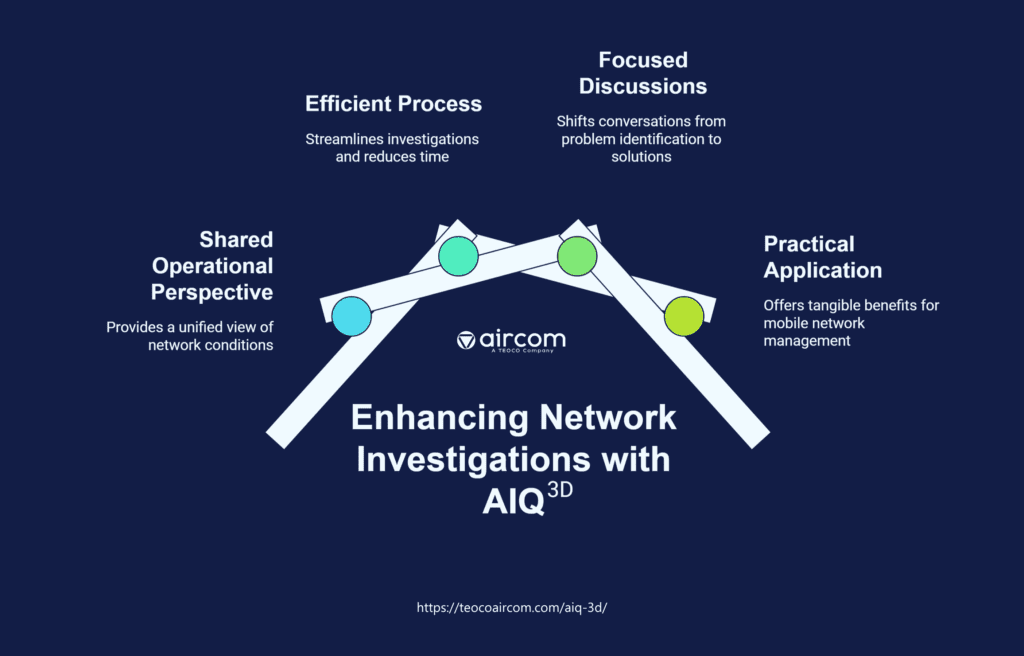
AIQ3D provides a shared operational perspective that helps teams align around the same understanding of network conditions. Instead of debating whether a problem exists, discussions now focus on the appropriate course of action.
That shift—from assembling evidence to interpreting it, and from diagnosis to resolution—may prove to be one of the most practical applications of digital twins in mobile networks today.