
Building Trust in AI: The Foundation for Autonomous Networks

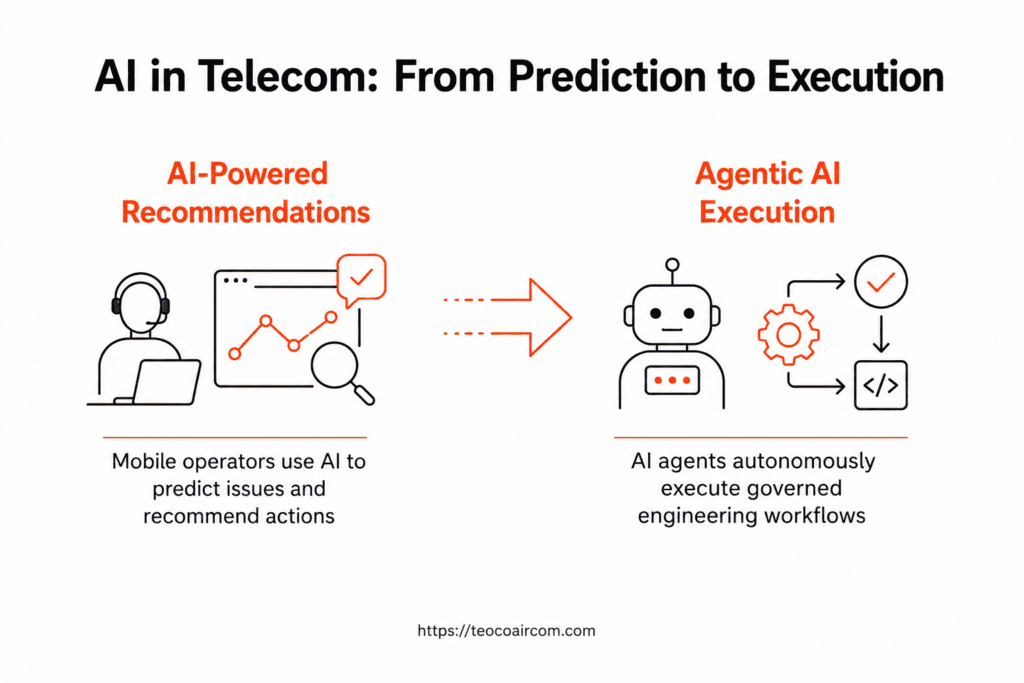
Artificial intelligence is not new to telecom. Operators already rely on AI to predict network issues, detect anomalies, optimize radio performance, forecast traffic, and improve planning decisions. These capabilities have delivered measurable gains in efficiency and network performance.
They have made networks smarter, but they largely stop at one point: they recommend what engineers should do next.
The challenge facing operators is no longer whether AI can improve network operations. It is whether AI can be trusted to execute them.
The next evolution is different. It is not about making better recommendations—it is about enabling Agentic AI to execute governed engineering workflows. This is where the industry is heading.
From Prediction to Execution
Modern mobile networks have become too complex for manual execution alone. Multi-vendor environments, Open RAN, dense 5G deployments, evolving service expectations, and increasing operational pressure require engineering teams to process more information and make faster decisions than ever before.
Human expertise remains indispensable, but relying solely on manual execution is no longer sustainable. Mobile networks continue to expand in scale and complexity, while the number of connected devices, applications, and services they support is growing exponentially. Engineering teams need AI that can automate routine workflows, enabling them to focus on decisions that require human expertise.
The next generation of AI must move beyond surfacing insights to investigating network data, executing structured workflows, and automating routine engineering activities under clearly defined governance. The objective is not to replace engineers, but to allow them to focus on decisions that truly require human expertise.
Trust Becomes the Operating Model
The greatest barrier to Agentic AI adoption is not technology—it is trust.
Telecom networks are mission-critical infrastructure where every engineering decision can directly affect customer experience and service continuity. Operators cannot rely on AI that behaves like a black box. Agentic AI must explain its reasoning, operate within engineering guardrails, produce repeatable outcomes, and remain fully traceable. Human oversight therefore becomes an essential part of the operating model, ensuring AI accelerates engineering without compromising operational control.
The AI Shift Across Other Industries
Telecom is not alone in this transition. Manufacturing, financial services, healthcare, and software engineering are all moving beyond AI-assisted decision-making toward Agentic AI that executes structured workflows under human supervision. These industries are not replacing experts; they are enabling experts to accomplish more through AI operating within clearly defined policies.
Telecom is now reaching the same inflection point—but with even greater expectations for governance, reliability, and accountability.
Turning Trust into Autonomous Networks
At Aircom, we believe Agentic AI will become one of the foundational technologies enabling autonomous networks. Its success, however, depends on combining intelligent execution with engineering governance and real-world context.
This is the thinking behind raNora, Aircom’s Agentic AI platform, where specialized AI agents support engineering teams by investigating network data, validating configurations, performing coverage analysis, and evaluating site planning options through governed, AI-assisted workflows.
Complementing this is AIQ3D, Aircom’s digital twin viewer, which adds the spatial context required to understand network performance in the real world. By visualizing coverage, customer experience, and radio behavior in three dimensions, it enables both engineers and AI systems to make better-informed decisions with greater confidence.
Autonomous networks will not be built simply by introducing more AI into telecom operations.
They will be built by introducing Agentic AI that operators can trust.
Trust is what transforms AI from an advisory tool into an operational partner. It is the foundation for autonomous networks—and the next chapter in telecom’s AI journey.
How can we help?
For over 30 years, Aircom has helped network operators run state-of-the-art mobile networks and profitable businesses. Learn how we can help you in the areas critical to the success of modern CSPs.