
6 Guardrails for Autonomous RAN Operations
In an autonomous RAN, an AI agent may do considerably more than identify a coverage issue. It could investigate network data, determine a possible cause, select an engineering action and potentially initiate that action within the network workflow.
Consider a simplified example: an agent identifies a coverage degradation and proposes changing an RF parameter on a group of cells. The recommendation may be technically sound—but should the agent be allowed to execute it?
That decision cannot depend on AI reasoning alone. It requires guardrails that determine whether the intent is clear, confidence is sufficient, network risk is acceptable, the action complies with operator policy, the user has the necessary authority, and human intervention is required.
This thinking is integral to raNora, Aircom’s Agentic AI platform for autonomous networks. raNora is designed to bring Agentic AI into RAN engineering workflows within defined engineering and operational boundaries. Guardrails are therefore not an additional layer around autonomy; they are part of what makes controlled autonomous execution possible.
So, what should CSPs consider when designing guardrails for autonomous RAN workflows?
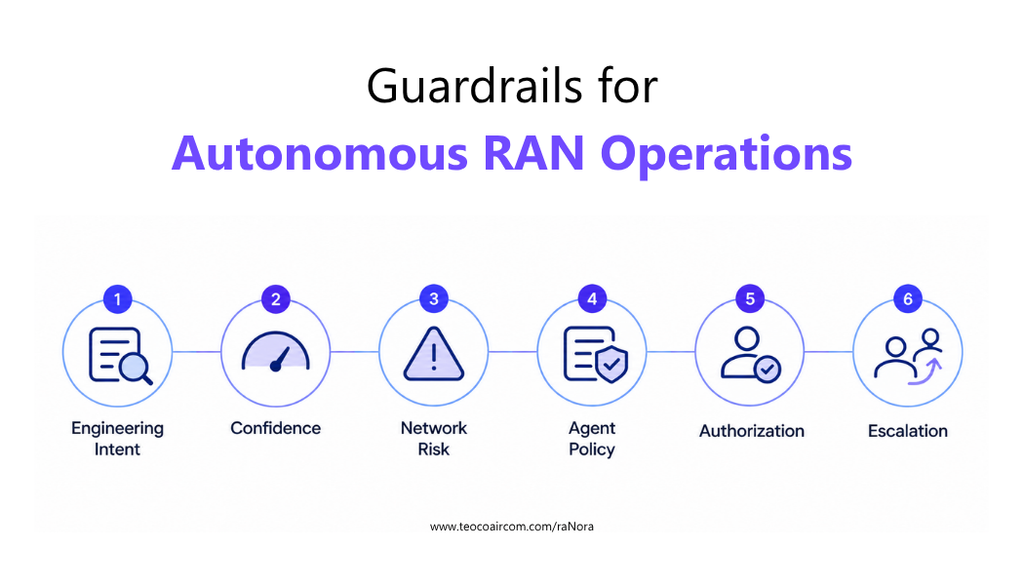
1. Is the engineering intent unambiguous?
Suppose an engineer asks an agent to “improve coverage in this area.”
For an autonomous workflow, that is not necessarily sufficient. Which geographic area? Which technology or layer? What network objective should be optimized? What constraints must remain unchanged?
Intent management should resolve or flag such ambiguity before execution begins. The agent should not translate an underspecified objective into network changes based purely on its own interpretation.
For RAN automation, the first guardrail therefore operates before any optimization takes place: is the engineering intent sufficiently precise to act upon?
2. Is confidence high enough for this particular action?
Assume the agent determines that an RF parameter adjustment is the appropriate response.
Its confidence now matters—but a single universal confidence threshold is unlikely to be sufficient. The threshold appropriate for generating a coverage report may not be appropriate for modifying network configuration.
The guardrail should therefore connect confidence to the action being considered. If confidence falls below the defined threshold, the workflow could perform additional analysis or move the proposed change to engineering review rather than execute it.
Confidence should influence what the agent is permitted to do next, not simply be reported alongside its output.
3. What is the network risk if the agent is wrong?
High confidence alone should not authorize execution.
Consider two proposed RAN changes. One affects a single cell and can be readily reversed. Another could modify parameters across dozens of cells in a high-traffic area.
Even at an equivalent confidence level, their operational risk is very different. A risk guardrail can therefore consider factors such as the number of affected cells and the reversibility of the proposed action before determining whether autonomous execution is appropriate.
This separates two important questions: How certain is the agent? And how much network exposure does its proposed action create?
Both matter.
4. Does the action comply with agent policy?
An action can be technically valid and still be operationally unacceptable.
Operators may define policies governing which actions an agent can perform, the network elements it can act upon, and the conditions under which execution is permitted.
These policies need to govern the agent rather than be left to its reasoning. An agent may identify a valid optimization action, but an applicable policy could still prevent its execution.
This creates an important separation between reasoning and authority: the agent can determine a possible course of action; operator-defined policy determines whether that action is permissible.
This principle is central to governed Agentic AI and to how raNora approaches the execution of RAN engineering workflows.
5. Is the agent authorized to execute it?
Policy compliance does not automatically mean execution is authorized.
If an engineer asks an agent to make a configuration change, the agent should not acquire broader privileges simply because it can access the workflow.
Role-based access and authorization controls need to apply to the requested action. An agent acting on behalf of a user should not be able to perform an operation that the user would not be authorized to perform directly.
This becomes increasingly important as Agentic AI connects different planning, configuration and operational environments.
Autonomy should preserve existing security boundaries, not bypass them.
6. When should the workflow escalate?
Now consider that the proposed change passes some guardrails but not others: confidence is acceptable, but the number of affected cells exceeds the permitted risk threshold.
The workflow should not simply terminate.
It can escalate the proposed action to an engineer, together with the relevant analysis and context, for approval or further investigation. Similarly, ambiguous intent, insufficient confidence, policy conflicts or authorization restrictions can each lead to an appropriate escalation path.
This makes human oversight more purposeful. Engineers intervene when defined conditions require engineering judgment, rather than being inserted into every autonomous workflow by default.
Designing Autonomy Around Engineering Control
The value of Agentic AI in the RAN will ultimately come from its ability to do more than analyze and recommend. It comes from enabling AI to participate meaningfully in engineering workflows while operating within boundaries that CSPs understand and control.
That is the approach behind raNora: combining Agentic AI with the engineering controls needed to support governed RAN workflows.
As CSPs move toward greater network autonomy, guardrails should not be viewed as constraints on that journey. They are what allow autonomy to progress with confidence—giving AI agents greater responsibility while keeping network risk, policy, security and engineering oversight firmly under control.
How can we help?
For over 30 years, Aircom has helped network operators run state-of-the-art mobile networks and profitable businesses. Learn how we can help you in the areas critical to the success of modern CSPs.