

RF Shaping: Are You Optimizing the Network — or Just Its Parameters?

Radio network optimization has always involved adjusting parameters. Electrical tilt, RF power and carrier configurations are fundamental tools for shaping coverage and performance. But the real opportunity is to connect those parameters with the data, analysis and automation needed to make faster, more informed decisions.
Traffic is not distributed evenly. Neither are buildings, clutter, user density or network demand. And the way traffic is distributed across carrier layers adds another dimension to the optimization problem. Bringing these inputs together through Aircom’s ASSET Suite and related solution capabilities enables RF teams to move from isolated parameter tuning to data-driven, repeatable optimization.
This is where RF Shaping brings a different perspective to radio network optimization.
What is RF Shaping?
RF Shaping is a data-driven approach to radio network optimization that evaluates how RF parameters can be adjusted according to where traffic occurs, the surrounding clutter and the behavior of multiple carrier layers. Using Aircom’s solution environment, RF teams can combine network data, geo-located traffic, user-experience data and RF prediction inputs to build a more complete view of the network.
Rather than looking at electrical tilt, RF power or individual performance targets in isolation, RF Shaping brings these factors together with geo-located traffic and RF prediction data. ASSET Radio can use traffic-map data as an input or weight layer to evaluate RF strategies, while ASSET Design support the broader network-data and optimization workflow. Mentor and ASSET CX can provide the geo-spatial and user-experience inputs needed to add further context to the analysis.
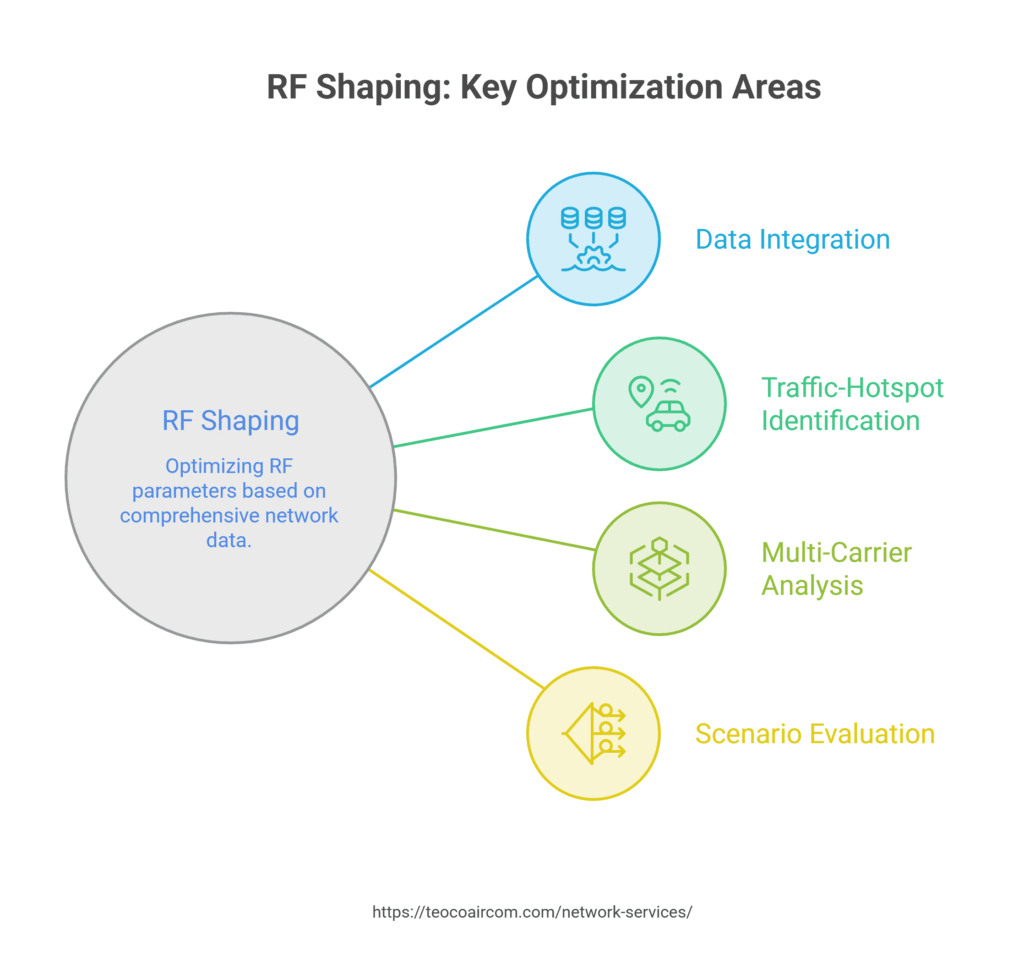
Automation is an important part of this workflow. Data from multiple sources can be integrated and prepared for analysis, traffic hotspots can be identified, and scenario-based RF strategies can be evaluated in a repeatable process. This reduces manual effort and enables teams to assess different optimization strategies in a shorter time before deciding where network changes should be considered.
In simple terms, RF Shaping asks not only “What RF parameter can we change?” but “Where should we change it, why, what else could that change affect, and how can the analysis be automated and repeated at scale?”
Are repeated RF configurations still right for the traffic they serve?
Similar electrical tilt configurations may exist across large numbers of cells. That does not necessarily mean they are wrong. But it creates an opportunity to ask whether those configurations remain appropriate for the environment and traffic each cell is serving.
By analyzing electrical tilt alongside geo-located traffic and clutter distribution in Mentor, RF engineers can identify where existing configurations should be retained and where alternative settings warrant evaluation. With automated data integration and analysis, these opportunities can be assessed consistently across the network rather than through isolated manual checks.
The objective is not simply to change more parameters. It is to make RF configuration decisions with greater awareness of the network environment and the demand within it — while using automation to make the analysis more efficient, repeatable and scalable.
What changes when traffic becomes part of the RF optimization decision?
Traffic maps can change the way an area is approached.
Instead of treating every part of the network with equal priority, geo-located network traffic in Mentor can identify high-traffic areas and hotspots. RF analysis can then focus more closely on locations where network demand is concentrated. Traffic from geo-located maps or other traffic-data sources can be brought into the RF workflow to prioritize areas that warrant attention.
This creates a stronger relationship between actual traffic distribution and decisions involving parameters such as electrical tilt and RF power. In ASSET Design, traffic-map data can be used as a weight layer to evaluate how different RF strategies perform against actual demand.
The result is a more targeted optimization question: Where could an RF change make the greatest difference?
What if improving one KPI affects another?
Radio network optimization rarely has a single objective.
A parameter change designed to improve one performance target can have consequences elsewhere. Evaluating an RF strategy against only one KPI can therefore provide an incomplete picture.
With ASSET Design, RF Shaping can evaluate different targets and combinations of targets, allowing engineers to examine potential trade-offs before deciding which strategy is appropriate. This helps RF planning teams evaluate potential improvements without optimizing one KPI at the expense of another.
The question moves from “Can we improve this KPI?” to “What does this change mean for the network as a whole?”
Can RF optimization be evaluated across multiple carrier layers?
Modern mobile networks operate across multiple carrier layers, with traffic distributed between them.
Analyzing carrier layers together makes it possible to evaluate different optimization targets and strategies while considering how traffic is distributed across the wider radio environment. Using ASSET Design, RF Shaping can evaluate several carrier layers within the same analysis, with different and combined targets defined as required. This broader view allows engineers to assess how changes in one layer may influence the overall radio environment.
That broader view matters. A configuration decision that appears appropriate when looking at one layer independently may look different when traffic and RF behavior across other layers are considered. Automation makes it practical to repeat these multi-layer analyses as inputs, targets or optimization strategies change.
RF Shaping: Putting Network Changes in Context
RF Shaping is ultimately about making RF optimization decisions in context. By combining network data from the ASSET Suite, geo-spatial inputs from Mentor, user-experience data from ASSET CX, clutter information, multiple carrier layers, RF prediction data and defined optimization targets, Aircom can evaluate different strategies before determining where network changes should be considered.
Automation connects these inputs into a repeatable workflow — from data integration and traffic-hotspot identification to multi-carrier analysis and scenario evaluation. This enables CSPs to assess different strategies in a shorter time, reduce manual analysis and apply data-driven RF optimization more consistently across the network.
For CSPs, this creates a more focused and automated approach to RAN optimization: not changing RF parameters simply because they can be changed, but understanding where change matters, what it could improve, and what else it could affect — with the ability to evaluate and refine strategies at scale.
How can we help?
For over 30 years, Aircom has helped network operators run state-of-the-art mobile networks and profitable businesses. Learn how we can help you in the areas critical to the success of modern CSPs.