

The First Steps Toward an Autonomous RAN

Telecom network planning faces growing challenges from increasing network complexity, 5G expansion, rising traffic demand, tighter CAPEX and OPEX budgets, and pressure to deliver faster network improvements with limited engineering resources. Traditional planning processes remain highly manual, time-consuming, and dependent on expert knowledge, making it difficult to respond quickly to changing network conditions.
Investing in automation and AI-driven planning enables operators to improve engineering productivity, reduce repetitive tasks, accelerate planning and optimization cycles, and make more accurate, data-driven investment decisions. Ultimately, this helps operators maximize the value of existing network assets, reduce operational costs, and improve network performance while preparing for increasingly autonomous networks.
As the industry moves toward Level 4 autonomy, the question for telecom operators is no longer just what autonomous networks can achieve, but how to make meaningful progress toward that goal. The challenge is not a shortage of potential applications. AI and automation offer opportunities across network planning, configuration management, optimization, and assurance. The real question is where to begin, particularly when operators must balance network performance, investment priorities, and operational efficiency.
The starting point should be use cases that address specific operational challenges, offer measurable business benefits, and create opportunities for progressively greater autonomy.
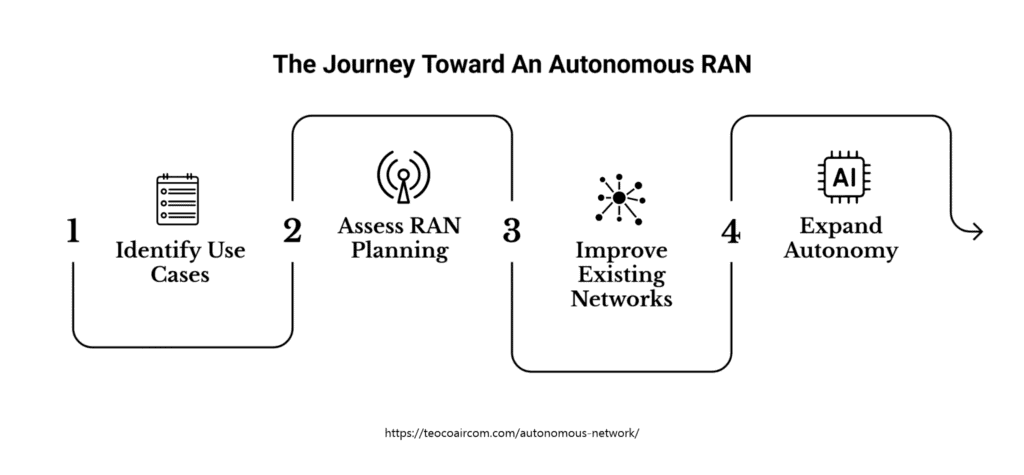
1. Identify Use Cases Where Intelligence Adds Value
Not every network process requires AI. Some activities are repetitive and rule-based, making them suitable for conventional automation. Others involve evaluating multiple alternatives, interpreting complex information, and making decisions under changing network conditions.
The distinction is important when prioritizing autonomous RAN initiatives.
CSPs should consider three factors:
- Business impact: Can the use case reduce OPEX, improve network performance, accelerate deployment, or support better investment decisions?
- Operational readiness: Are the necessary data, systems, and interfaces sufficiently reliable to support automated workflows?
- Potential for autonomy: Can the process progress beyond automated execution toward intelligent decision-making and closed-loop operations?
Two areas offer particularly relevant starting points: RAN planning and improving the efficiency of existing networks.
2. RAN Planning: From Lengthy Engineering Studies to Faster Investment Decisions
Consider an operator evaluating network expansion in a high-demand market.
Should it deploy new sites, upgrade existing infrastructure, or optimize current network configurations to meet coverage and capacity requirements?
Each alternative carries different costs and implementation timelines.
Traditionally, evaluating these options requires several stages of engineering analysis. Planning teams gather and validate network information, develop deployment scenarios, run simulations, assess results, and refine recommendations. The process can involve multiple iterations across different systems and teams.
AI-assisted planning offers an opportunity to compress this decision-making cycle without compromising engineering accuracy.
By combining reliable network data, automated workflows, and AI-assisted analysis, operators can reduce the effort involved in preparing and comparing planning scenarios. Digital-twin capabilities can provide additional context for evaluating how proposed changes may affect coverage and performance.
For CSPs, the potential value extends beyond engineering productivity. Faster evaluation of alternatives can support more timely investment decisions, improve CAPEX allocation, and accelerate responses to commercial opportunities.
RAN planning is therefore a relevant candidate for greater autonomy: it combines established engineering processes with opportunities for intelligent analysis and workflow automation.
3. Existing Networks: Improving Accuracy Before Adding Complexity
For established operators, improving existing infrastructure can be as valuable as expanding it.
Consider configuration management across thousands of network cells. As networks evolve, configuration changes may introduce discrepancies between actual network settings, approved policies, and planning databases.
These inconsistencies can affect engineering efficiency, complicate troubleshooting, and reduce confidence in planning decisions.
Automated configuration auditing can identify deviations from established policies and support corrective actions. Maintaining consistency between live network information and planning databases offers another practical opportunity.
Aircom’s Agentic AI platform, raNora, provides an example. Engineers can use natural-language instructions to initiate workflows that identify discrepancies between live OSS information and the ASSET planning database and support their correction using updated network data.
The immediate benefits include reduced manual effort, improved data accuracy, and more reliable information for network planning.
Over time, AI-driven analysis could extend these capabilities by helping operators evaluate network behavior and recommend configuration changes to improve performance.
This represents a progression from correcting known inconsistencies toward more intelligent network operations.
4. Expand Autonomy Based on Demonstrated Results
Once a use case is implemented, the next question is whether it delivers sufficient value to justify expansion.
For planning workflows, CSPs can measure reductions in planning cycle time, engineering effort, and the time required to evaluate investment alternatives.
For existing network operations, relevant measures include configuration accuracy, manual interventions, and the time required to identify and resolve discrepancies.
Successful workflows can then provide a foundation for more advanced capabilities.
A possible progression toward greater autonomy:
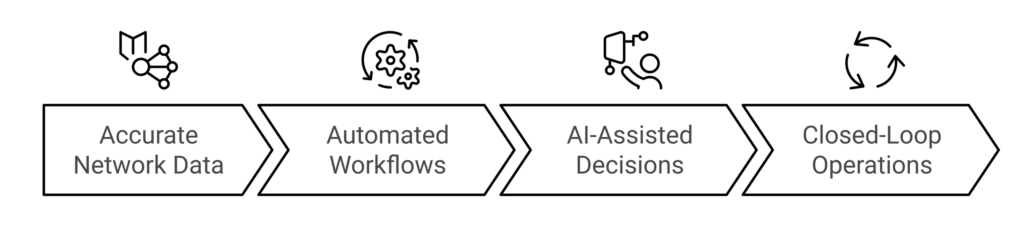
Supported throughout by appropriate validation, governance, and operational controls.
This progression is not necessarily linear. Different network functions may advance at different rates, depending on their complexity, readiness, and business requirements.
Making Autonomy Deliver Business Value
The journey toward autonomous RAN does not require a network-wide transformation from the outset.
It can begin with a planning process that takes too long, a configuration discrepancy that creates unnecessary work, or an operational workflow that depends heavily on manual intervention.
What matters is whether introducing intelligence and automation improves the outcome.
For CSPs, progress toward Level 4 autonomy should be measured not only by increasing automation, but by the improvements it delivers in network economics, operational efficiency, and service performance.
How can we help?
For over 30 years, Aircom has helped network operators run state-of-the-art mobile networks and profitable businesses. Learn how we can help you in the areas critical to the success of modern CSPs.