
Platform Health: The Key to Reliable Agentic AI

The telecom industry is entering the era of Agentic AI. Intelligent agents are beginning to diagnose faults, optimize radio networks, validate configurations, recommend corrective actions, and increasingly execute those actions with limited human intervention.
Much of the discussion focuses on large language models, orchestration frameworks, reasoning capabilities, multi-agent collaboration, and industry initiatives. These are undoubtedly important. However, they all share a common dependency that is often overlooked:
An AI agent cannot make good decisions if it cannot trust the platform and data it operates on.
Autonomous behavior foundation is operation and data reliability
Before an AI agent in telecom can reason about a network, recommend an optimization, or trigger an automated workflow, it must have confidence that the underlying system is healthy, the incoming data is complete, and every processing stage is functioning correctly.
Without that foundation, even the most sophisticated AI becomes another source of uncertainty. It will create another output of incorrect results that will occupy or load system operations and engineer time.
Reliability is not an operational concern—it is an AI requirement
Platform health is the continuous validation of the systems, data, and engineering workflows that AI agents rely on to make trustworthy decisions.
Traditional monitoring focuses on keeping applications running. Agentic AI raises the bar considerably.
An autonomous agent continuously consumes information, correlates multiple data sources, generates engineering conclusions, and may ultimately initiate network changes. Every decision depends on the quality and integrity of the information flowing through the system.
If data silently stops arriving, processing pipelines become delayed, or correlations are incomplete, the AI rarely has enough context to recognize that something is wrong. Instead, it produces recommendations based on partial or outdated information.
The result is not simply reduced system performance.
It is reduced trust in autonomous decision-making.
This is why health monitoring must evolve from measuring infrastructure availability to validating the entire engineering intelligence pipeline.
Two complementary dimensions of system health
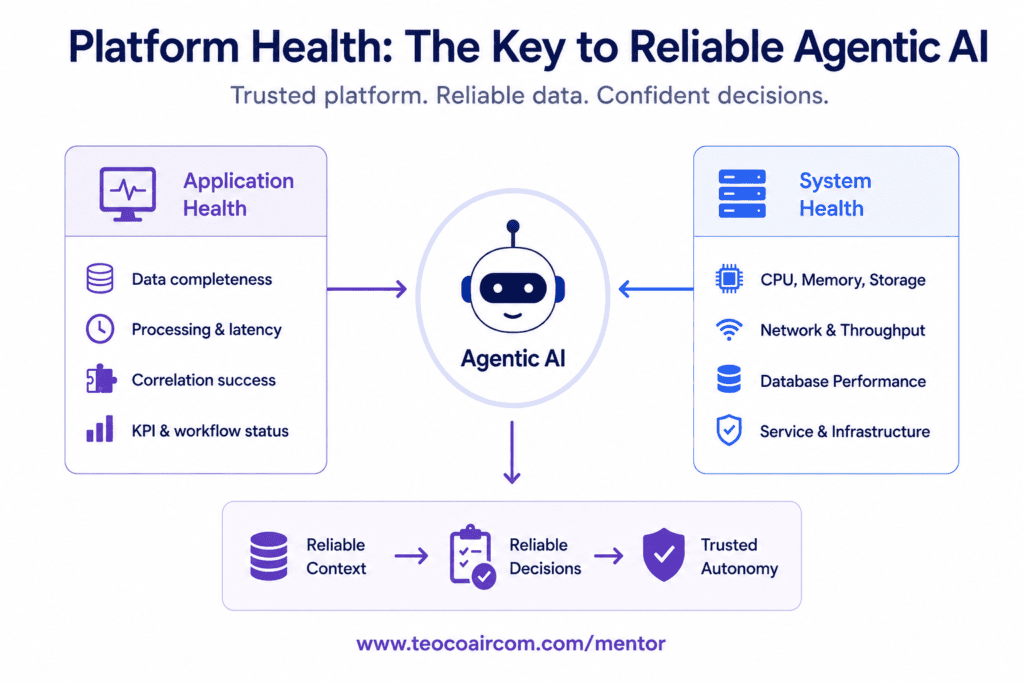
For Agentic AI, platform health consists of two complementary dimensions: Application Health and System Health.
1. Application Health – Can the platform trust its own intelligence?
Application health answers a fundamental question:
Is the engineering data being processed correctly?
Engineering data includes network topology, configuration data, performance measurements, subscriber behavior, geolocation, historical trends, engineering rules, and previous optimization actions.
Unlike conventional application monitoring, this extends far beyond checking whether services are running.
A trustworthy platform continuously validates:
- Data source availability and connectivity
- Data completeness across all expected feeds
- Missing files or delayed deliveries
- Processing latency throughout the ingestion pipeline
- Task execution status and operational success
- Correlation success between independent data sources
- Data consistency across processing stages
- Engineering KPI generation
- AI workflow execution and orchestration status
Consider a geolocation platform processing signaling events, performance measurements, and configuration data.
Even if a specific report is “healthy,” the platform may still be producing incomplete engineering intelligence because:
- The source system stopped delivering trace files due to a fault, resource limitation, or configuration issue. From the application’s perspective, processing completed successfully—but only on the incomplete data that was received.
- A processing queue accumulated several hours of delay, causing late data arrival. As a result, the platform was temporarily unable to correlate all required data sources, leading to incomplete engineering context.
- Configuration updates were not synchronized with the live network, resulting in discrepancies between the network inventory and the actual physical deployment.
From an infrastructure perspective, everything appears operational.
From an AI perspective, the platform is no longer trustworthy.
This distinction becomes increasingly important as AI agents move from answering questions to making decisions.
2. System Health – Can the platform sustain autonomous operation?
The second dimension focuses on the platform itself.
Agentic AI platforms often execute hundreds or thousands of concurrent tasks involving large-scale data processing, machine learning, vector searches, inference requests, and orchestration across distributed services.
Continuous monitoring should include:
- CPU, memory, and storage utilization
- Network throughput
- Database performance
- Processing queue depth
- Service availability
- Container and orchestration health
- Hardware failures
- Resource contention
- System faults and recovery events
- Overall platform capacity
Infrastructure health ensures that the platform can continue operating reliably under production workloads without becoming a bottleneck for autonomous decision-making.
AI requires trusted context—not just data
One of the defining characteristics of Agentic AI is that decisions are rarely based on a single input.
Agents combine multiple layers of information, including:
- Network topology
- Configuration data
- Performance measurements
- Subscriber behavior
- Geolocation
- Historical trends
- Engineering rules
- Previous optimization actions
This contextual understanding is what allows an AI agent to distinguish between a genuine network issue and a temporary anomaly.
However, context is only as reliable as the systems that generate it.
If even one critical data source becomes incomplete or delayed, the AI’s understanding of the network can become distorted. A missing configuration update may lead to an incorrect root-cause analysis. Delayed performance counters may hide an emerging congestion problem. Incomplete correlation may produce misleading engineering conclusions.
Reliable context therefore depends on continuous validation of the entire information chain—not simply monitoring individual applications.
Observability for autonomous networks
As operators move toward higher levels of network autonomy, observability must evolve as well.
Future-ready platforms should not only detect infrastructure failures but also measure the health of the engineering intelligence itself.
Examples include:
- Is every expected data source arriving on time?
- Is today’s data volume consistent with historical behavior?
- Are engineering correlations completing successfully?
- Are processing delays affecting AI recommendations?
- Are optimization tasks executing within expected time windows?
- Is the platform operating within its performance limits?
- Can AI recommendations be trusted at this moment?
These questions become as important as traditional metrics such as CPU utilization or service uptime.
In autonomous systems, the quality of decisions depends directly on the quality of observability.
Building trust before building autonomy
The telecom industry often discusses Agentic AI in terms of reasoning, planning, and automation. Yet the success of autonomous networks will ultimately depend on something much less visible.
Trust.
Operators will only allow AI agents to perform increasingly autonomous actions when they have confidence that the underlying platform is continuously validating itself—its data, its processing, its correlations, and its operational health.
Reliable data creates reliable context.
Reliable context enables reliable decisions.
Reliable decisions enable trusted autonomy.
System health monitoring is therefore no longer an operational dashboard maintained by support teams. It becomes a strategic capability that continuously verifies whether an AI platform is ready to reason, recommend, and act.
Because before an autonomous agent can optimize a network, the platform itself must first prove that it is healthy enough to be trusted.
That is, Agentic AI is only as autonomous as the platform it runs on.
How can we help?
For over 30 years, Aircom has helped network operators run state-of-the-art mobile networks and profitable businesses. Learn how we can help you in the areas critical to the success of modern CSPs.